
The United Nations is set to vote Wednesday on a resolution condemning the decades-long U.S. economic embargo on Cuba as the Trump administration intensifies its campaign to undermine Cuba's socialist government, including by threatening military intervention.
The annual exercise aimed at calling out the U.S. government’s “maximum pressure policy” has been put before the U.N. General Assembly for the past 34 years, and each time the resolution has received overwhelming support from the 193 member states. Last year, the vote was 165-7, with 12 abstentions.
And while it is still expected to pass by a large margin this year, it is unclear if the Trump administration’s overt campaign to influence the vote will result in more opposition or abstentions from key countries — including Western allies — than it has in previous years. While such resolutions are not legally binding, they reflect world opinion.
The vote before the world body comes as Cuba is weathering deepening financial crises while the U.S. increases its already punishing economic campaign. On top of this, President Donald Trump last week once again raised the specter of U.S. military intervention, saying U.S. warships could stop over in Cuba on their way back from the Iran war.
The tensions between Washington and Havana have spilled over into public forums at the United Nations.
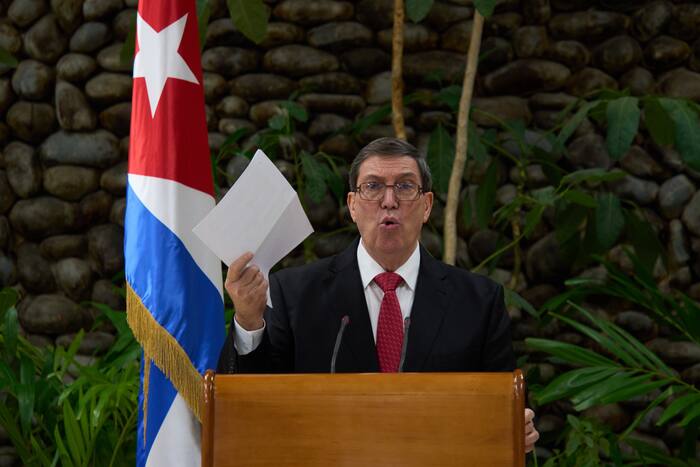
On Tuesday, U.S. Ambassador to the U.N. Mike Waltz and Cuban Foreign Minister Bruno Rodríguez found themselves in a shouting match on the floor of the General Assembly while debating the embargo resolution.
Shortly after Waltz had begun his criticism of the socialist government, Rodríguez walked down to the podium where the U.S. envoy was addressing the hall and called him a liar while trying to get a “point of order” from the official presiding over the session.
“This individual needs to back away from this podium. He’s not going to intimidate me in the United States of America,” Waltz said as U.N. security and personnel tried to intervene. "You understand who you’re dealing with? This is America. Back up.”
In a post on X, Rodríguez reminded Waltz where he was making his remarks, saying he's at the U.N., not at a national security meeting at the White House.
“With his crude lies at the UN General Assembly, the U.S. government has launched another desperate attempt to justify its economic aggression against Cuba and its criminal energy blockade,” he continued.
A week earlier, a similar interaction between Waltz and his Cuban counterpart, Ernesto Soberón Guzmán, took place outside a U.S.-hosted panel with Cuban dissidents and former prisoners that sought to highlight allegations of the oppressive behavior of the island’s government.
It all reflects a clear break from the traditional diplomatic decorum expected at the U.N. and the new phase of contentiousness between the U.S. and Cuba.
The U.S. embargo against Cuba was first imposed in 1960 after Fidel Castro led a revolution that toppled dictator Fulgencio Batista and nationalized properties belonging to U.S. citizens and corporations.
As a result, the Caribbean country has spent decades facing the dire impact of longtime economic and financial troubles and is now being pushed to a breaking point after Trump, a Republican, announced in late January that he would impose tariffs on any country that sells or provides oil to Cuba. The warning has effectively cut off fuel to the island, leading to widespread power outages that affect basic activities such as cooking, the water supply and internet and telephone services.
___
Associated Press writer Dánica Coto in San Juan, Puerto Rico, contributed to this report.


